

If you’ve done the hard yards, through bariatric surgery, years of steady effort, or with the help of the newer weight-loss medications, you have already achieved something remarkable. Body contouring is about the part your body couldn’t spring back from by itself: the loose, hanging skin, the uneven fat, and the changes in shape that don’t reflect the work you’ve done to get here.
I see many people after major weight loss, and I’m glad to be working at a time when there are so many ways, surgical and non-surgical, to help. The people who come to me for body contouring have lived full lives: weight that has gone up and down, pregnancies, all the changes a body goes through. After major weight loss the tissues very often don’t spring back. For some, the tissue never had the chance to develop as it should, because weight difficulties began very early in life.
It is rarely about appearance alone. Excess skin can cause back pain, rashes and soreness in the skin folds, difficulty with hygiene and with fitting clothes, and it can limit how you exercise and live your life fully.
The evidence also suggests that people who complete their weight-loss journey with body contouring tend to maintain their weight loss better. Some of that is surely the commitment that brings a person to this point. But it does appear that finishing the journey this way helps people hold their ground.
It’s never “just about the skin”
Underneath the skin sits the connective tissue that stabilises your shape: the fascia and the musculo-aponeurotic system. After major weight loss or pregnancy it has lost its elasticity and can’t return to its place on its own. Fat sits in different layers and different patterns, and this framework can no longer hold and contain the body as it should.
In an abdominoplasty especially, I think about tensegrity: the integrity of the whole musculo-fascial system that supports the body, from the back, through the pelvic floor, round to the front. So the work isn’t simply removing something. It’s repositioning the fascia and connective tissue, and restoring the anatomy of the whole structure, so the body is supported the way it’s meant to be.
Each tissue is treated in its own way:
- The fat is shaped with liposuction, which I use across almost everything I do. Used for the right purpose, it is a very valuable part of the surgery.
- The connective tissue, the fascia and musculo-aponeurotic system, is repositioned and secured in place.
- The skin is trimmed, rejoined and reshaped so it sits where it should.
There is no single recipe for everyone.
Your goals, in your terms
I want to understand your paradigm: what you are aiming for, and why it matters to you. My role is to help you achieve that, in your terms.
When you come in, I’ll ask you to show me where the heaviness or excess sits day to day, and what you instinctively do about it: the tucking in, the holding, the lifting, the hiding. That natural movement very often points straight to the right operation.
The question I’m really asking isn’t “what’s the biggest change we could make?” It’s what’s most appropriate for you: the least surgery that gives the most improvement in your particular situation.
The options
Depending on what your body needs, your plan may include:
- Abdominoplasty (tummy tuck), sometimes with repair of the abdominal muscles
- Extended or fleur-de-lis abdominoplasty, for more excess around the abdomen
- Back lift or body lift, so the front and back are addressed together
- Arm lift (brachioplasty)
- Breast lift or breast reduction, often combined with the arms
- Thigh lift (thighplasty)
- Liposuction, used alongside most of these
Often it’s a combination, planned around you.
About the fleur-de-lis abdominoplasty
A standard tummy tuck tightens the abdomen from top to bottom. After major weight loss there is often loose skin from side to side as well. A fleur-de-lis abdominoplasty addresses both, by adding a vertical scar down the centre of the abdomen to the usual low horizontal scar. It suits some people after major weight loss, but it does mean more scarring, so we weigh it carefully together.
Arms and thighs: contour and comfort
Arms and thighs are a real part of body contouring after weight loss, and they don’t get talked about enough. When you raise them, the first thing I’ll ask is what’s driving it. Is it the heaviness, or the shape? Arms you can’t put in a short sleeve; thighs that rub, or keep you out of shorts.
These operations exchange heaviness and discomfort for better contour and comfort, and a scar. Wearing a sleeveless top again is a very reasonable goal.
A scar is something you choose and earn, and you look after it. The heaviness and discomfort of the tissues were never your choice. They don’t belong to you, and they aren’t your signature. We talk this through together, so the exchange is one you truly want.
One operation, or several?
Body contouring after major weight loss is almost always done in stages. Not everything can, or should, be done in one go. Here is one possible plan:
- Upper body: an arm lift, often combined with breast surgery (a lift or reduction, as needed).
- Lower body: an abdominoplasty with a back lift, so the front and back are treated together.
- Thighs: a thigh lift, along with any touch-ups from earlier stages.
The stages are interchangeable. The order is set by your priorities: what affects your comfort, function and daily life most is usually addressed first. Commonly that’s two to three stages in all, with time to recover in between, but your plan may look different.
I’m also upfront about revisions. After major weight loss the tissues have been stretched, and aged, far more than usual. So it’s not unusual for a smaller touch-up to be needed a few years later. That isn’t a failure. It’s the nature of contouring a body that has been through a great deal, and I’d rather you knew from the start.
Am I ready?
You may be ready when:
- your weight has been stable, usually for around six months
- your life is settled, with good support around you
- you are in good general health, and you don’t smoke or are willing to stop
- you are ready to keep up healthy living, before and after surgery
- you understand the scars and the recovery involved
I want to understand what has helped you become your best you, and what has held you back. Then we work with your body, your emotions, your life and your circumstances, so that you not only achieve your result, but keep it.
If you’re still losing weight, including with medication, you’re welcome to come and see me early so we can plan. The surgery itself waits until your weight has settled.
This is a long journey, and the relationship runs long too. People often come back years later, because life and ageing don’t follow a straight line. Patients sometimes laugh that we’re about to become their new best friends, because we’ll be seeing so much of each other.
Surgery and recovery: the honest picture
These are major operations, and I can’t overemphasise that. Recovery takes weeks and weeks: garments to wear, scars to care for, and a period of feeling deconditioned before you rebuild your strength.
I think of surgery like a sandwich: well prepared going in, the operation in the middle, then back to healthy living for the rest of your life. I favour a “prehab” approach: as strong and prepared as possible beforehand, with every risk assessed in advance and a plan to manage it. The scars are permanent. I place them as carefully as I can, but I’d never pretend they aren’t there. These are not operations to rush into. They are operations to prepare for.
More on this: recovery after surgery, deciding on post-weight-loss surgery and loose skin after weight loss.
Risks and complications
All surgery carries risk, and body contouring after major weight loss is significant surgery. Possible complications include bleeding, infection, delayed wound healing, raised or widened scars, changes in sensation, fluid collections (seroma), asymmetry, and the risks of anaesthesia and longer operations, including the small risk of serious complications such as blood clots. Because the tissues have been stretched and altered, healing can behave differently. We go through your own risks carefully at your consultation, with a plan for how we’d manage each one. Please read our risks and complications information in full before deciding.
What surgery can, and can’t, do
Surgery doesn’t replace healthy living. It only works well in a healthy body. If something can still be reached with diet and exercise, that comes first. Surgery is not an escape from the hard work. It’s the opposite.
What surgery can do is help restore what your body couldn’t recover on its own, after major weight loss, or after pregnancy where there is real muscle separation that exercise can’t correct. I can’t do the hard work for anyone. But I’d be honoured to help consolidate the result of all of yours.
How much does body contouring cost in Melbourne?
No two plans are the same, so there is no single price. Your quote includes the surgeon’s fee, anaesthetist, surgical assistant and hospital costs, and depends on which procedures you need and how they are staged. You’ll receive a clear, itemised quote after your consultation.
Most purely cosmetic body contouring is not covered by Medicare. Some procedures may be eligible for a Medicare item if you have lost significant weight (equivalent to at least five BMI points), your weight has been stable for at least six months, and the excess skin causes a genuine functional problem, such as a skin condition that hasn’t settled with treatment, or difficulty with daily activities. Repair of abdominal muscle separation after pregnancy may also qualify in specific cases. Eligibility is assessed at your consultation and is never automatic.
See costs of surgery, Medicare cover and payment plans.
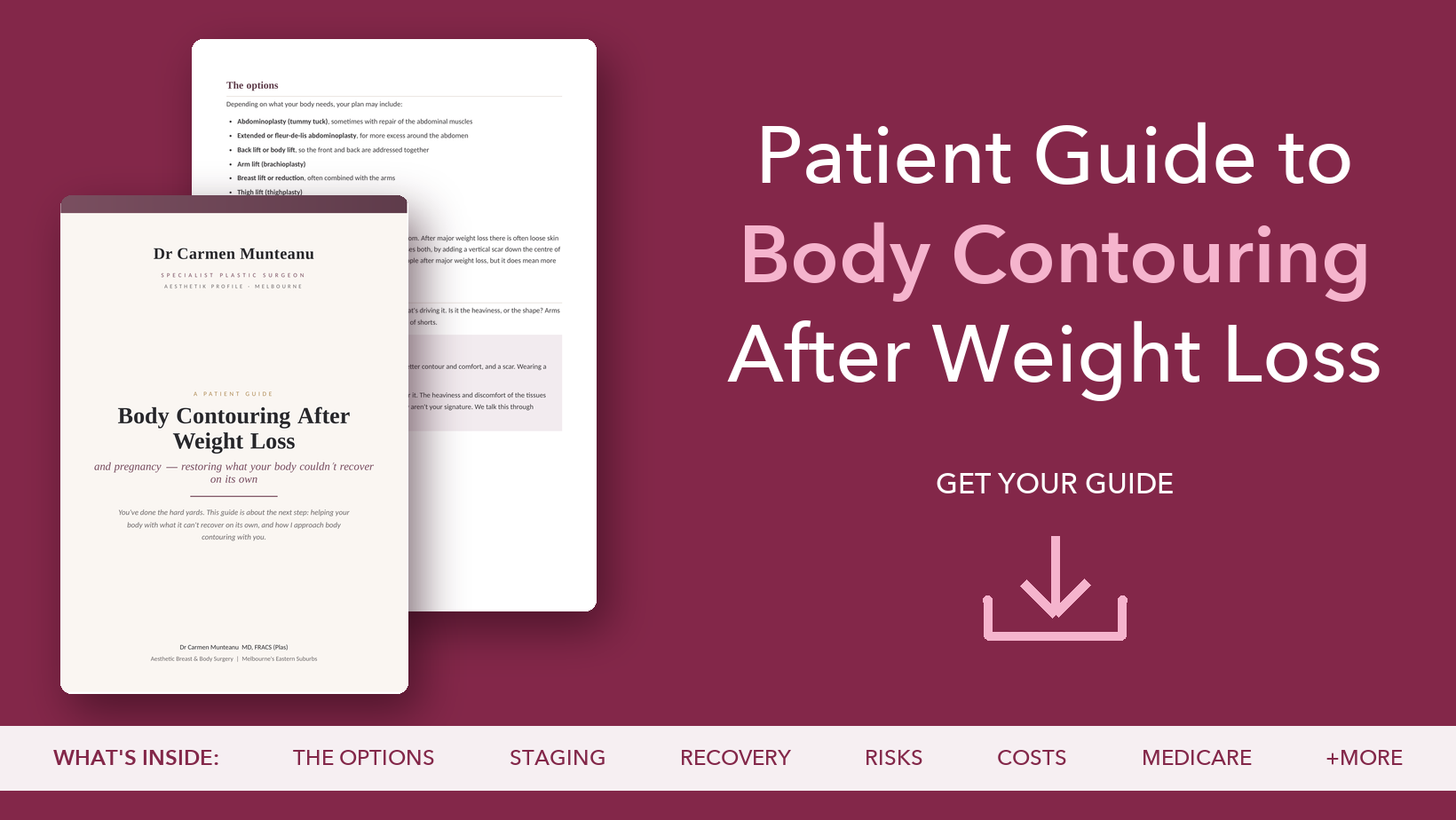
Download the patient guide
Planning your surgery and your consultation
At your consultation we’ll talk about what has brought you here and what you’d like to change. I’ll examine you, and we’ll go through what’s realistic, how the stages might fit together, where the scars would sit, and what recovery involves. There is no obligation to go ahead.
A GP referral is essential for any type of surgery, so please arrange one before your appointment.
- Phone: (03) 9852 0545
- Rooms: Aesthetik Profile, 246 Mitcham Road, Mitcham VIC 3132
- Consultation fee: $300, payable when you book. A GP referral is required.
Dr Carmen Munteanu, MD, FRACS (Plas), Specialist Plastic Surgeon, over 25 years of surgical experience. AHPRA MED0001211281. Board certified by the Australian and New Zealand Board of Cosmetic Plastic Surgery (recertified annually). This page is general information only and is not personal medical advice. All surgery carries risks, and individual results vary. Content intended for people aged 18 and over.